
By The Fiber Optic Academy · · 6 min read
Splicing joins two optical fibers end to end so light passes from one to the other with as little loss as possible. There are two ways to do it: fusion splicing, which welds the glass together, and mechanical splicing, which holds two cleaved fibers in precise alignment. Each has a place, and a good technician knows when to use which.
How Fusion Splicing Works
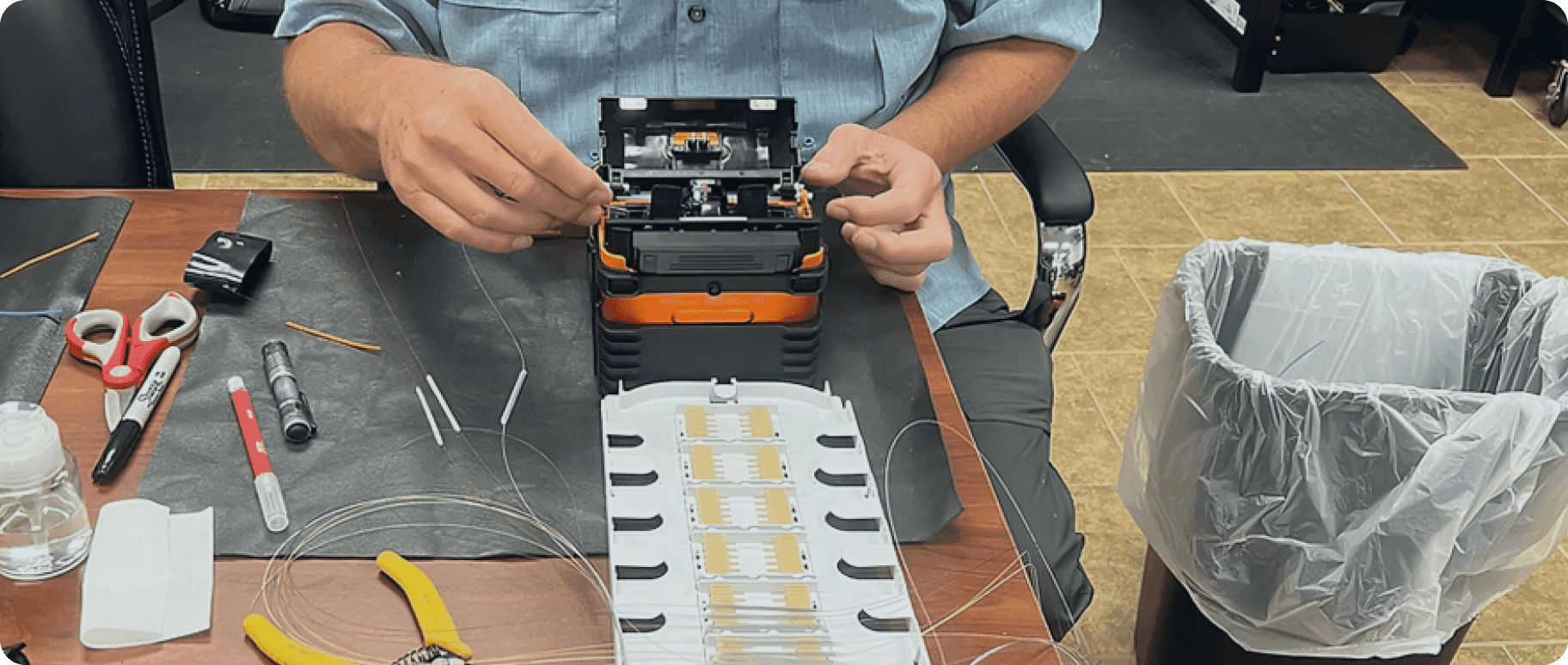
The technician strips and cleans both fibers, cleaves them to get flat, perpendicular end faces, and loads them into a fusion splicer. The splicer aligns the fibers and fuses them with an electric arc. The finished splice is protected with a heat-shrink sleeve and placed in a splice tray.
- Lowest loss: a good fusion splice typically measures only a few hundredths of a dB.
- Virtually no reflectance, which matters for high-speed and analog video systems.
- Strong and permanent once sleeved and stored in a tray.
- Higher equipment cost: a fusion splicer and a quality cleaver are a significant investment.
How Mechanical Splicing Works
A mechanical splice is a small device with an alignment channel and index-matching gel. The technician cleaves both fibers and pushes them into the splice until they meet. The gel reduces reflection at the gap between the fiber ends.
- Low tool cost: no splicer needed, only stripping tools and a good cleaver.
- Quick to learn and useful for restoration or small jobs.
- Higher loss and some reflectance compared with fusion splices.
- Splice performance depends heavily on cleave quality and cleanliness.
Side by Side
- Typical use: fusion for outside plant, long-haul, FTTH feeder and distribution; mechanical for temporary repairs, restoration and some premises work.
- Loss: fusion is lower; mechanical is higher and more variable.
- Reflectance: fusion is negligible; mechanical is low but measurable.
- Cost: fusion has high equipment cost but low cost per splice; mechanical has low equipment cost but a higher cost per splice for the consumable.
- Skill: both depend on careful stripping, cleaning and cleaving.
Which Should You Learn?
Both. Most outside plant and FTTH work today is fusion spliced, so employers expect technicians to be comfortable with a fusion splicer, splice trays and closures. Mechanical splicing remains a handy skill for restoration and small installs. Whichever method you use, the fundamentals are the same: clean preparation, a good cleave, and verifying your work with an OTDR. See our guide on how to read an OTDR trace.
Learn to Splice Hands-On
Our CFOT course introduces both fusion and mechanical splicing. The CFOS/S splicing specialist course goes deeper: cable preparation, fusion splicing, placing splices in trays and closures, and testing splices with an OTDR, leading to the FOA CFOS/S certification.
Ready to get splicing experience? Contact TFOA about our next CFOS/S class.